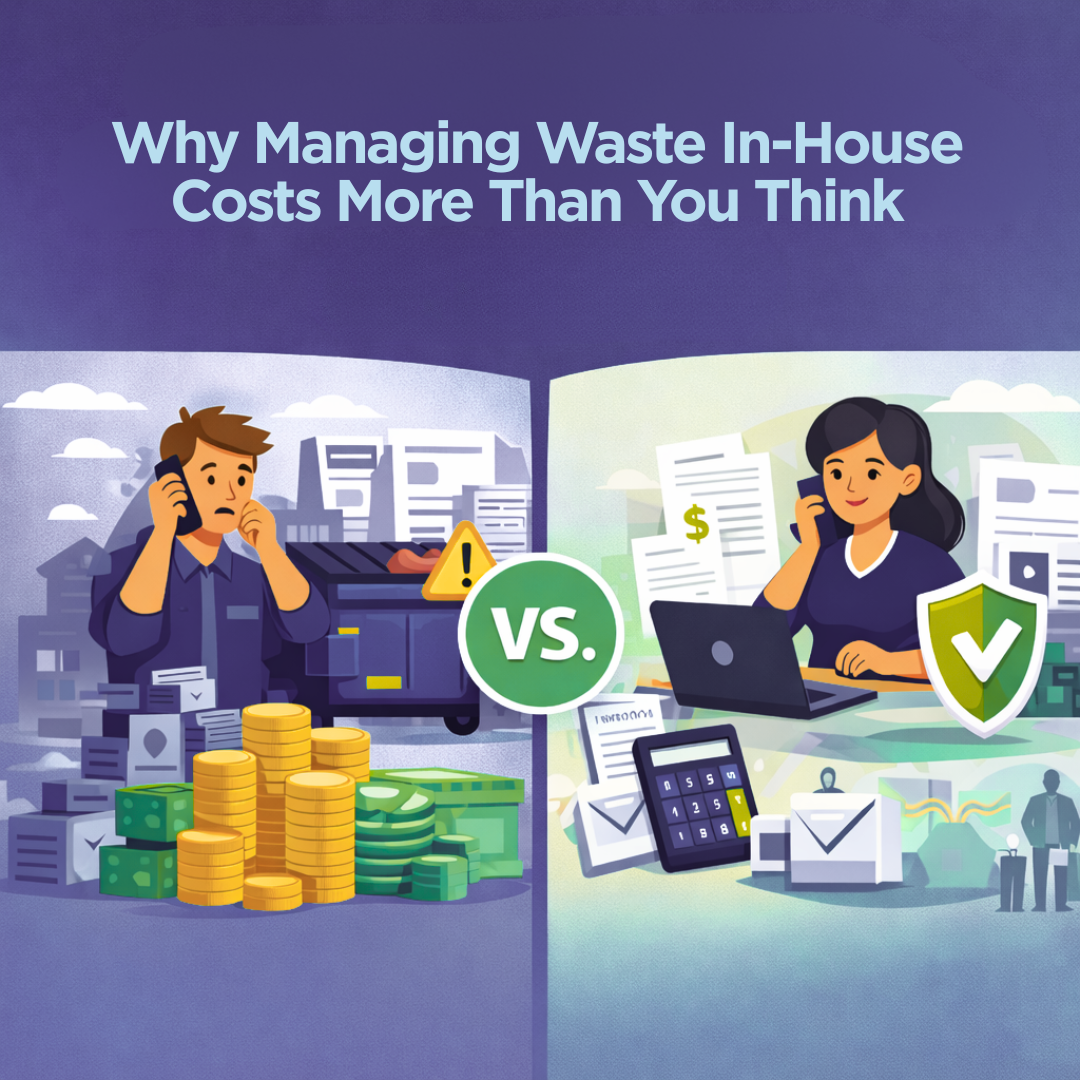
When organizations assess their waste and recycling programs, the focus is usually on service rates, bin sizes, or sustainability goals. But hiding behind the bins is a far less visible cost driver: the full-time staffing required to manage hauler relationships.
In a fragmented hauler-direct model, businesses spend significant internal resources dispatching service calls, handling billing issues, managing contracts, and collecting sustainability data. These activities rarely fall under one person’s job title, but collectively, they represent a surprising administrative load that can equate to several full-time equivalent (FTE) employees.
By contrast, a full-service waste and recycling partner acts as a centralized administrator, removing much of this burden by owning vendor relationships, dispatching, billing reconciliation, and reporting.
Let’s break down what that looks like in terms of real-world staffing and cost savings.
The In-House Burden: What It Takes to Manage Waste Directly
A national or multi-site business that goes hauler direct would engage with 10–20+ independent waste vendors, each with their own schedules, systems, and points of contact.
Here are the core functions this company needs to manage internally:
1. Dispatching & Service Management
- Handling missed pickups, overflow issues, damaged bins, and service requests.
- Managing access issues, contamination notices, or bylaw infractions.
- Coordinating with haulers for service changes (frequency, size, access).
- Communicating with site managers and vendors.
- Answering questions from field teams.
Time requirement: 1 FTE for every 75–100 sites.
2. Accounts Payable & Invoice Reconciliation
- Receiving and coding invoices from every hauler.
- Matching invoices to expected service levels.
- Disputing overcharges and contamination fees or verifying weight-based pricing.
- Preparing accruals and handling re-bills.
Time requirement: 1 FTE for every 100–150 invoices/month (typically 1 per site per hauler).
3. Contract Management & Vendor Oversight
- Tracking expiration/renewal dates.
- Comparing rate changes and service level agreements.
- Managing RFPs for new services or vendors.
- Ensuring compliance with service agreements.
- Negotiating, managing, and tracking rates and price increases with current vendors.
Time requirement: 0.25–0.5 FTE depending on scale.
4. Sustainability & Compliance Reporting
- Collecting and standardizing diversion data from multiple haulers.
- Aggregating monthly or quarterly reports for ESG or internal scorecards.
- Resolving data gaps and inconsistencies.
- Training staff and/or tenants/building occupants on local waste practices.
- Supporting waste audits or provincial reporting mandates (e.g., Ontario RPRA).
Time requirement: 0.5–1 FTE depending on ESG scope.
Total In-House FTE Estimate (100 sites, hauler-direct):
- Dispatch & Service Management: 1
- Accounts Payable & Invoicing: 1.0
- Vendor Oversight: 0.5
- Sustainability Reporting: 1.0
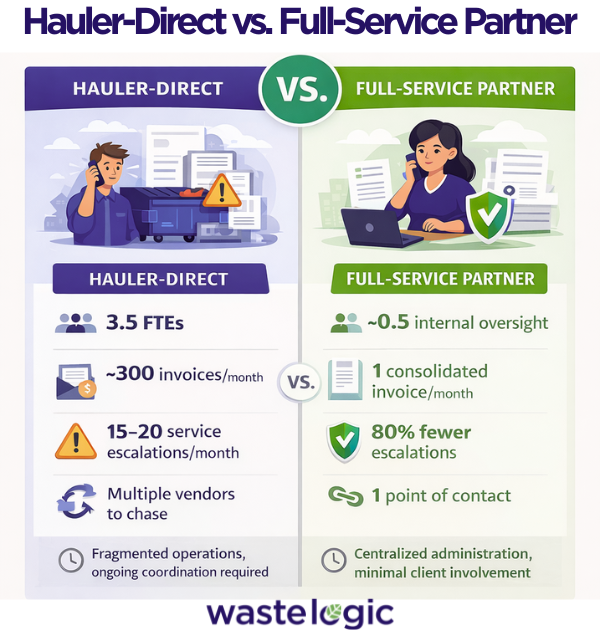
- Total: 3.5 Full-time Equivalent Staff.
Staff Turnover & Knowledge Loss (Often Overlooked)
Beyond day-to-day administration, staff turnover introduces another hidden cost in a hauler-direct model. Waste and recycling management relies heavily on institutional knowledge: vendor contacts, site-specific service nuances, historical pricing, contamination rules, and escalation paths. When employees leave, that knowledge often leaves with them.
New hires must be trained to understand multiple hauler systems, contracts, invoicing structures, and local waste regulations; training that takes weeks or months before they are fully effective. During transition periods, service issues, billing errors, and missed optimization opportunities are more likely to occur, increasing operational risk and internal workload.
This cycle of onboarding, retraining, and knowledge rebuilding adds time, cost, and inconsistency to in-house waste management. Costs that rarely appear on a budget line, but compound over time.
Administrative Cost Savings
Let’s assume that the average cost per full-time employee who would complete this work is $70,000/year (salary + benefits + overhead). Partnering with a full-service waste and recycling partner would save approximately $245,000/year in soft administrative costs (based on 100 sites).
What a Waste and Recycling Partner Absorbs
When you partner with a full-service waste and recycling partner, you offload nearly all the above-mentioned functions. Waste partners centralize and manage dispatch, administration, and invoicing, replacing the need for in-house staff to handle these functions.
Here’s what happens when you work with a full-service waste and recycling partner:
Centralized Dispatch Team
Waste and recycling partners, like Waste Logic, have dedicated teams who manage hauler scheduling, site changes, overflow events, and escalations. These teams are equipped with internal routing software, escalation processes, and hauler relationships that speed up resolution times.
Client Impact: Site managers no longer need to call haulers directly, and operations no longer need to chase missed pickups and coordinate schedule adjustments.
What once could take 40 hours a week or more of your staff’s time now requires zero involvement. That’s equivalent to the time of one full-time employee that can now be refocused on your core business activities.
Invoice Consolidation & Audit
Waste and recycling partners consolidate all hauler invoices into a single monthly bill, with pricing validated, exceptions flagged, and documentation attached. They also dispute incorrect charges and reconcile hauler bills on the client’s behalf. All while offering real-time visibility into cost by location.
Client Impact: Accounts payable (AP) only need to process one invoice, drastically reducing accounting overhead.
The result? Your AP team processes 1 invoice instead of 50–200, with no need to verify pricing or chase down credits. On average, this cuts AP time by 80–90%, saving another 1 FTE or more.
Contract & Vendor Oversight
Full-service waste and recycling partners, like Waste Logic, take on the vendor management role. They act as the single point of contact for contract compliance, vendor performance management, and enforcing service-level agreements. At Waste Logic, we also have our Continuous Cost AnalysisTM (CCA) program where we ensure you have the right service at the best price without the need for a costly and time-consuming RFP process.
Client Impact: No need to track contract calendars or manually compare pricing across vendors. Your business works with one entity instead of a patchwork of vendors.
Instead of a facilities manager or procurement person spending 20 hours per week fielding site complaints or coordinating vendor changes, that effort is absorbed by the waste and recycling partner. Savings: 0.5 FTE or more.
Sustainability Reporting & Analytics
Full-service waste and recycling partners compile diversion and waste volume data across all haulers. Offering dashboards, custom reports, and ESG summaries for investor reports.
Client Impact: Sustainability managers get centralized, normalized data without spending hours collecting data and reformatting spreadsheets.
When a business doesn’t have a specialized sustainability role in-house, it takes even more time to uncover and understand the number in front of them. A full-service waste and recycling partner like Waste Logic has a sustainability department, offering their expertise to the clients they work with. Saving another 1 FTE or more.
Scalability Without Staff Additions
As your organization grows, whether opening 5 new sites or acquiring 50, internal administrative burdens multiply if you're managing haulers directly. Every new location introduces:
- A new hauler relationship
- Additional contracts and expiry dates to manage
- Additional service tickets
- More invoices to process
- More data to consolidate
With a waste and recycling partner, the model scales without increasing your internal headcount. The administrative load is absorbed as part of the service offering.
Real-World Impact: What Could You Do With That Time?
These administrative savings free up internal bandwidth that can be redirected to higher-value work. Here's how organizations repurpose that capacity:
- Operations teams focus on strategic site improvements instead of chasing hauler issues.
- Procurement teams spend more time on cost optimization, ESG alignment, or cross-category sourcing.
- Accounting teams increase automation and reduce month-end crunch times.
And of course, the hard cost savings from not needing to hire or reallocate staff can be redirected into growth initiatives, sustainability programs, or margin improvement.
Real-World Example
A national retailer with 300 stores transitioned from managing 18 haulers directly to a brokered program. Internally, they had 3.5 FTEs across operations, finance, and sustainability dedicated to waste administration. After centralizing through a full-service waste and recycling partner:
- Invoice volume dropped from 300/month to 1/month.
- Quarterly business review reports were generated externally.
- Accounts payable and operations teams redeployed 2 FTEs to more strategic tasks.
- Annual estimated savings: $200,000+ in admin time alone.
Final Thought: Focus on Core, Not Trash
For most businesses, waste is not a core competency, but efficient administration is critical to avoiding chaos and cost creep. Choosing to manage haulers directly may seem cheaper on the surface, but when you account for the internal FTEs required to do it well, the equation flips.
A full-service waste and recycling partner doesn’t just save you money; they give your team time back. Time to focus on customers, growth, and sustainability initiatives, not garbage calls and invoice audits.
Contact Waste Logic to discuss how a free waste assessment can highlight how a managed waste services partner could save your organization time, money, and valuable resources.
Let your team focus on what really matters. We’ll handle the waste.